How to Ship a Car to Another State: Complete Guide (2026)
This step-by-step guide walks you through exactly how to ship a car — from getting your first quote to inspecting your vehicle at delivery. Whether you're relocating for work, buying a car online, or sending a vehicle to a college student, you'll know exactly what to expect at every stage of the car shipping process.
Step 1 — Get Multiple Quotes
The first step when you want to ship your car to another state is gathering quotes. We recommend getting at least three to five estimates so you can compare pricing, timelines, and service quality.
What affects your car shipping quote:
- Distance: A coast-to-coast shipment (e.g., New York to California) costs more than a regional move (e.g., Georgia to Florida).
- Vehicle size and weight: Shipping a compact sedan is cheaper than shipping an SUV or truck.
- Transport type: Open transport is the standard and most affordable option. Enclosed transport costs 30–50% more.
- Time of year: Snowbird season (October–March) drives up prices on routes to and from Florida and Arizona.
- Pickup and delivery locations: Door-to-door service in urban areas is straightforward. Rural or hard-to-reach locations may require terminal pickup.
Red flags to watch for:
- Quotes significantly below the market average — this often leads to delays or hidden fees.
- Companies that demand large upfront deposits before assigning a carrier.
- No USDOT or MC number listed (check on FMCSA's website).
Pro tip: When you request a quote from SendMyRide.com, you get a transparent, all-inclusive estimate with no hidden fees. We show you the real market rate so you can make an informed decision.
Step 2 — Choose Your Transport Type (Open vs Enclosed)
Once you have your quotes, you'll need to decide between two main transport methods:
Open Transport
- Best for: Most standard vehicles — sedans, SUVs, trucks, minivans.
- Cost: $500–$1,200 for most interstate routes.
- How it works: Your car rides on an open multi-car carrier (the same type you see on highways carrying new dealership inventory).
- Pros: More affordable, more carriers available, faster pickup times.
- Cons: Your vehicle is exposed to weather and road debris (though damage from this is extremely rare).
Enclosed Transport
- Best for: Luxury cars, classic vehicles, exotics, high-value automobiles.
- Cost: $800–$2,000+ for most interstate routes.
- How it works: Your car is loaded into a fully enclosed trailer, protected from all elements.
- Pros: Maximum protection, ideal for vehicles over $50,000 in value.
- Cons: Higher cost, fewer carriers available, potentially longer wait for pickup.
Bottom line: About 85% of customers choose open transport. It's safe, proven, and cost-effective. If your vehicle has significant financial or sentimental value, enclosed is worth the premium.
Step 3 — Prepare Your Vehicle for Shipping

Take detailed photos of your vehicle from every angle before shipping day.
Proper preparation is one of the most important parts of the car shipping process. Here's your complete vehicle prep checklist:
Must-do before shipping:
- Document existing damage with photos. Walk around your entire vehicle and photograph every scratch, dent, and ding. Include close-ups and wide shots. Date-stamp the photos. This is your proof if any new damage occurs during transit.
- Remove all personal items. Carrier insurance does not cover personal belongings left inside the vehicle. Remove electronics, documents, clothing, and anything loose. Most carriers allow up to 100 lbs in the trunk, but we recommend removing everything.
- Keep the gas tank at 1/4 full. A full tank adds unnecessary weight and cost. One-quarter tank is enough for loading and unloading.
- Disable your car alarm. If your alarm goes off on the carrier, the driver can't easily stop to address it. Deactivate aftermarket alarms or leave clear instructions.
- Check for open recalls. Visit NHTSA.gov and enter your VIN. Resolve any safety recalls before shipping.
- Wash your vehicle. A clean car makes it much easier to spot and document any pre-existing damage during the inspection.
- Secure or remove loose parts. Fold in side mirrors, retract antennas, remove bike racks, spoilers, or any aftermarket accessories that could catch wind or snag during loading.
- Check tire pressure and battery charge. Your vehicle needs to roll on and off the carrier. Ensure tires are properly inflated and the battery is charged.
Key management:
Keep one set of keys with the carrier driver and one set with you. The driver needs keys to load, position, and unload your vehicle. Never send your only set of keys with the car.
Step 4 — Book and Confirm Pickup
Once you've chosen a carrier and transport type, it's time to book.
What to expect during booking:
- Confirm pickup and delivery addresses. Provide exact addresses or the nearest major intersection if you're in a rural area.
- Agree on a pickup window. Most carriers provide a 1–3 day pickup window rather than an exact date. Flexibility helps secure better rates.
- Review the contract. Read the terms of service, cancellation policy, and insurance coverage details before signing.
- Payment terms. Reputable brokers typically collect a small deposit at booking, with the balance due at delivery (paid directly to the carrier driver).
Questions to ask before booking:
- What is the carrier's insurance coverage and deductible?
- What is the cancellation or rescheduling policy?
- Is there a guaranteed pickup date or a window?
- How will I be updated on my shipment's status?
At SendMyRide, we walk you through every detail at booking so there are zero surprises later.
Step 5 — Vehicle Pickup Day (What to Expect)
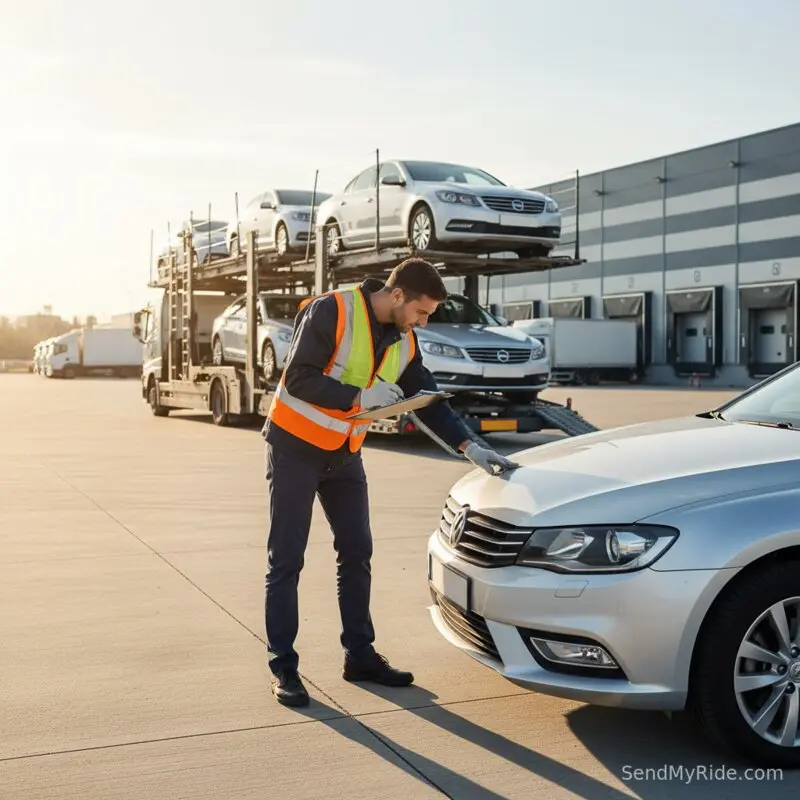
The carrier driver will conduct a thorough inspection of your vehicle before loading.
Pickup day is when the car shipping process becomes real. Here's what happens:
The Bill of Lading (BOL)
The carrier driver will conduct a joint vehicle inspection with you and document the car's condition on a Bill of Lading (BOL). This is the most important document in the entire shipping process.
- Walk around the vehicle together with the driver.
- Note every existing scratch, dent, chip, and ding on the BOL.
- Do not sign the BOL until you agree with the condition report. If you see something the driver missed, speak up.
- Take your own photos at this point as backup.
- Keep a copy of the signed BOL — you'll need it at delivery.
Loading the vehicle
- The driver will drive or roll your vehicle onto the carrier.
- Your car will be secured with wheel straps and/or tire nets.
- The process typically takes 15–30 minutes per vehicle.
Before the truck leaves:
- Confirm the driver's contact information.
- Confirm the estimated delivery window.
- Confirm how you'll receive status updates.
Step 6 — Track Your Shipment
Once your car is on the road, you'll want to know where it is.
How tracking works:
- Broker updates: Your shipping broker (like SendMyRide) stays in contact with the carrier and provides regular status updates via phone, text, or email.
- GPS tracking: Some carriers offer real-time GPS tracking. Ask about this when booking.
- Driver contact: You should have the driver's phone number for direct communication.
Typical transit times by distance:
| Route | Distance | Estimated Transit |
|---|---|---|
| Same region (e.g., NY to PA) | Under 500 miles | 1–3 days |
| Mid-range (e.g., TX to FL) | 500–1,000 miles | 3–5 days |
| Cross-country (e.g., CA to NY) | 2,500+ miles | 7–10 days |
Step 7 — Delivery and Final Inspection

Receiving your vehicle at your new home — the final step in the car shipping process.
Delivery day is the last — and most critical — step. Here's how to handle it:
When the truck arrives:
- Inspect your vehicle thoroughly before signing the delivery BOL. Compare the vehicle's current condition to the pickup BOL and your photos.
- Check for any new damage. Look at all panels, the roof, hood, trunk, bumpers, wheels, and underneath if possible.
- Note any discrepancies on the BOL. If you find new damage, document it on the delivery BOL before signing. Take photos immediately.
- Test the vehicle. Start the engine, check that it drives properly, test the lights and turn signals.
If there's damage:
- Note it on the BOL and take photos.
- Contact your shipping broker immediately.
- File a claim with the carrier's insurance. Reputable carriers carry $750,000+ in cargo insurance.
- Your documented photos from pickup day are your strongest evidence.
Payment at delivery:
The remaining balance is typically paid to the carrier driver at delivery. Have the agreed payment method ready (cash, cashier's check, or sometimes Zelle/Venmo — confirm in advance).
Common Mistakes to Avoid When Shipping a Car
Even experienced shippers make these errors. Avoid them to ensure a smooth experience:
- Choosing the cheapest quote without research. Rock-bottom prices often mean unreliable carriers, hidden fees, or long delays. Value reliability over saving $50.
- Not documenting vehicle condition. Without photos and a thorough BOL review, damage claims become nearly impossible to prove.
- Leaving personal items in the car. Carrier insurance explicitly excludes personal belongings. Items can also shift and damage your car's interior during transit.
- Not reading the contract. Understand cancellation policies, insurance coverage, and what happens if pickup is delayed.
- Expecting an exact pickup date. The auto transport industry works on pickup windows, not guaranteed dates. Build 2–3 days of flexibility into your schedule.
- Forgetting to disable the alarm. A blaring alarm on a moving carrier is a problem no one wants.
- Signing the delivery BOL without inspecting. Once you sign, you're confirming the car arrived in the stated condition. Inspect first, always.
- Not checking carrier credentials. Verify USDOT and MC numbers. Confirm active authority and insurance on the FMCSA website.
Why Choose SendMyRide
- Instant, transparent quotes — no hidden fees, no bait-and-switch pricing.
- Licensed and insured carriers — every carrier in our network is FMCSA-verified with active authority and insurance.
- Dedicated support — a real person guides you from quote to delivery. You're never left wondering what's happening with your car.
- Open and enclosed options — we match you with the right transport type for your vehicle and budget.
- Nationwide coverage — we ship cars to and from all 50 states.
- Thousands of satisfied customers — our reputation is built on delivering cars safely and on time.
Frequently Asked Questions
How much does it cost to ship a car to another state?
Interstate car shipping typically costs between $500 and $1,500 depending on distance, vehicle size, transport type (open vs enclosed), and seasonal demand. Cross-country routes (2,500+ miles) are at the higher end, while shorter regional moves are more affordable.
How long does it take to ship a car across the country?
Most cross-country shipments take 7–10 days from pickup to delivery. Shorter routes (under 500 miles) typically take 1–3 days. These timelines can vary based on weather, carrier routes, and seasonal demand.
Is my car insured during shipping?
Yes. All licensed carriers are required to carry cargo insurance (typically $750,000 or more). This covers damage that occurs during transit. However, carrier insurance does not cover personal belongings left inside the vehicle.
Can I put personal items in my car during shipping?
Technically, some carriers allow up to 100 lbs in the trunk. However, we strongly recommend removing all personal items. They're not covered by insurance, and loose items can shift and damage your car's interior during transport.
Do I need to be present for pickup and delivery?
You or an authorized representative must be present at both pickup and delivery to conduct the vehicle inspection and sign the Bill of Lading. If you can't be there, you can designate someone with a signed authorization letter.
How do I prepare my car for shipping?
Key preparation steps include: wash the car, document existing damage with photos, remove personal items, keep the gas tank at 1/4 full, disable the alarm, check for recalls, and ensure the battery is charged and tires are inflated. See our detailed prep checklist in Step 3 above.
What is a Bill of Lading?
A Bill of Lading (BOL) is the official transport document that records your vehicle's condition at pickup and delivery. It serves as a receipt, a contract of carriage, and your primary evidence if you need to file a damage claim. Always review it carefully before signing.
Can I ship a non-running vehicle?
Yes, but it costs more. Non-running vehicles require special equipment (a winch) to load and unload. Let your shipping broker know upfront if your vehicle doesn't start or can't roll, brake, and steer — this affects carrier assignment and pricing.